myQ Community
- 4.4
- Rating
- 100.00K
- Installs
- Free
- Price

 Analysis by App-foxy
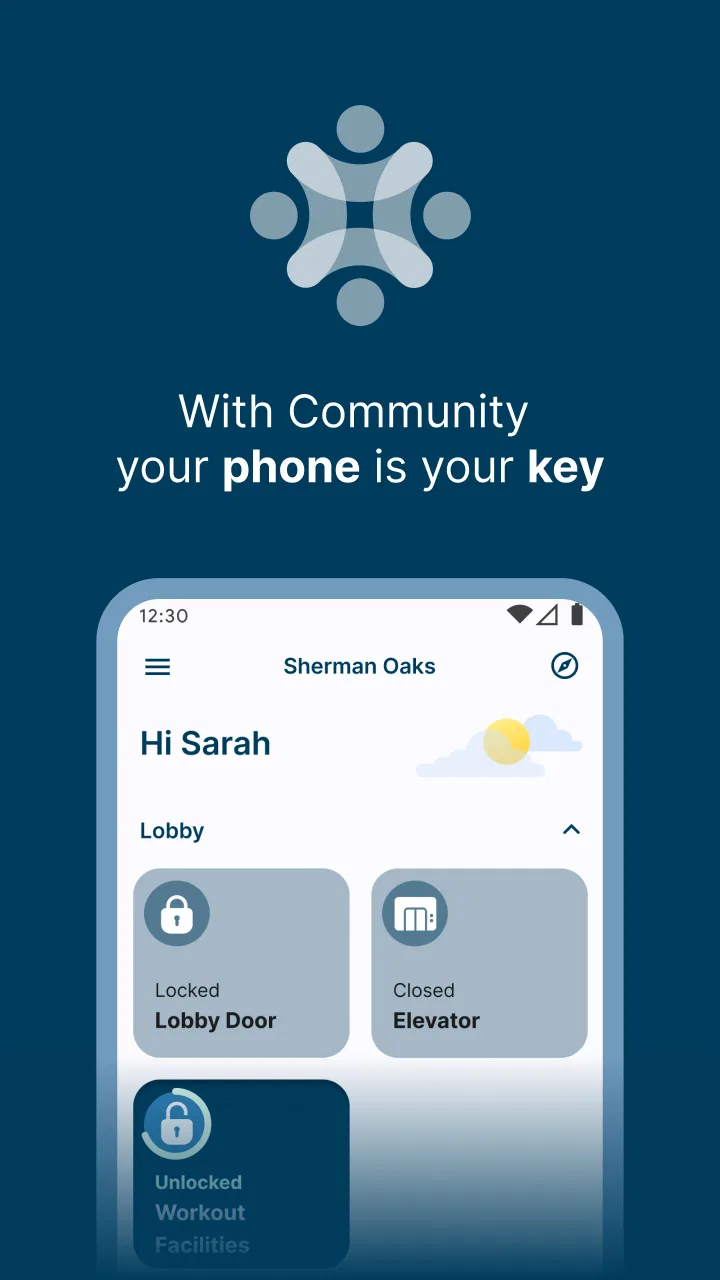
Managing access to a residential community can become surprisingly complicated when entry depends on shared gates, garages, doors, and changing resident details. I found myQ Community most useful as a focused lifestyle app for that exact setting. It is made for property managers and residents rather than for general smart-home control, and that narrower purpose gives it a clearer role than many broader home-automation apps.
The app comes from The Chamberlain Group LLC and is free to use. It has an age rating of Everyone, runs on operating systems from version 10 onward, and its current version is 7.0.45.478333. Those details matter if you are deciding whether an older phone can handle it or whether the app is suitable for a household with different generations using the same community access system.
How myQ Community feels to use in everyday access situations
I find the everyday value of myQ Community is easiest to judge by looking at the small moments around shared entry: arriving with full hands, learning an unfamiliar building’s access routine, or helping a household member understand which route to use. Those situations reward a clear, predictable process more than a long list of functions. The next section considers how that practical focus plays out for residents and property managers.
You May Also Like

 Pandora - Music & Podcasts
Pandora’s Music Is Easy to Start, but Harder to Recover
Pandora’s strength is its low-effort path from a seed to a station. Its weak spot is how much confidence it asks you to place in connection, setup, and quiet recovery.

 AccuWeather: Weather Radar
AccuWeather Review: A Quick, Clear Forecast for Everyday Decisions
For everyday plans, the best forecast is the one you can understand quickly. AccuWeather makes rain timing, radar, and local conditions easy to act on, with a few trade-offs.

 Hill Climb Racing
Why Hill Climb Racing Still Turns Crashes Into One More Run
A tiny car, a bumpy hill and one more upgrade: Hill Climb Racing keeps resurfacing because its simple chaos makes every near-miss feel personal.

 AliExpress - Shopping App
AliExpress Makes Global Shopping Feel Personal, but Shoppers Bear the Risk
AliExpress turns a global marketplace into a pocket-sized discovery engine. Its reach is useful, its shopping loop compelling, and its trade-offs easy to miss.

 Lords Mobile: Kingdom Wars
Lords Mobile Is a Kingdom-Building Routine, Not a Quick Match
A case-by-case verdict on the building, battles, device demands, and social commitments that make Lords Mobile rewarding for some players and exhausting for others.

 PDF Scanner app - TapScanner
TapScanner Makes Paperwork Easier to Capture, Check, and Share
TapScanner makes scanning with a phone feel less like a rescue operation and more like a dependable step in getting work done. Its capture tools are useful, though not flawless.
More From Our News Desk
View All News


Readability and navigation for residents and managers
My first impression was that the app’s value depends less on entertainment or customization and more on whether it helps me complete an access task without hesitation. A resident generally wants to know where to go to use community access, while a property manager needs a more administrative view of the same environment. Keeping those roles in mind makes the app easier to judge: it is not trying to replace every building-management tool, but to give both sides a digital route into shared access.
The interface is most effective when I approach it with one clear goal, such as getting through an entrance or handling access connected with my residence. That focused workflow is helpful for people who dislike crowded dashboards. It also reduces the need to remember several unrelated menus. On the other hand, newcomers may still need a short period of exploration because the experience is tied to the way a particular property has configured its access system.
That property-specific element is important. Two residents can use the same app but encounter different access arrangements, so the app should not be judged as though every screen and action will be identical everywhere. If a building has a simple setup, the experience can feel direct. If a manager has organized several access points or resident groups, the usefulness of the app depends partly on how clearly those details have been arranged.
I would recommend setting up and checking the app before standing outside a gate or garage. This is a small but meaningful accessibility tip: learning the navigation while relaxed is easier than trying to read a screen in a hurry, in poor weather, or while carrying bags. It also gives a resident time to notice whether text, buttons, and labels are comfortable to read on their particular phone.
For property managers, the app’s strength is that it places community access in a resident-facing digital channel instead of relying entirely on physical credentials or repeated manual explanations. That can make routine access communication easier. Still, a manager should not assume that installing the app alone solves every onboarding problem. Residents may use different phones, have different levels of confidence with apps, or need help understanding which access areas apply to them.
Motor and sensory considerations
Digital access can remove some physical friction. A resident may not need to search for a key fob, handle a small remote, or remember which physical credential belongs to which entrance. For someone with limited dexterity, reducing the number of objects to manipulate may be useful. The benefit is practical rather than magical: the phone becomes one familiar item, although using it still requires reaching, holding, tapping, and looking at the display.
I would be careful about assuming that phone-based access is automatically easier for every user. A person with hand tremors, reduced fine-motor control, or difficulty holding a phone steadily may find small touch targets demanding. Someone with low vision may need to adjust the phone’s display settings or use the operating system’s built-in assistance tools. Those adjustments are device-dependent, so I would test them before relying on the app for time-sensitive entry.
People with hearing-related needs may appreciate that an access workflow does not have to depend on listening for a particular sound, but the app should not be treated as a complete substitute for every building communication method. A resident may still need visual confirmation, clear instructions from management, or another way to understand what is happening at an entrance. Likewise, users who are sensitive to glare should test the screen outdoors, where reflections can make any phone interface harder to read.
One useful habit is to enlarge the phone’s text and display elements before the first real use, then check whether the app remains comfortable without forcing awkward scrolling. Another is to keep the phone charged when leaving home, since a digital access method is only convenient while the device is usable. These are not special features of the app, but they are realistic parts of making it work for different abilities.
I also think about cognitive load. A resident who is tired, stressed, or unfamiliar with the property may not remember a complicated sequence. The best setup is one where the user can identify the relevant community and access action quickly. Managers can help by giving residents plain-language instructions and by avoiding unnecessary differences between the way access is explained in notices and the way it appears in the app.
Situational access: where the app helps most
A realistic example is arriving home with groceries while the weather is unpleasant. Instead of searching through a bag for a physical credential, I can take out the phone I already use and open the community access app. That is a meaningful convenience, especially when the entrance process is familiar and the phone is ready. It is less impressive if I first need to solve an account issue, find an unfamiliar access point, or stand in a location where the screen is difficult to see.
The app can also be useful during a move or a change in living arrangements, when access needs are connected with a residence rather than with a single permanent object. For managers, a digital resident workflow may be easier to coordinate than explaining every access detail repeatedly in person. For residents, the main advantage is having community-related access information in a place they can check themselves.
There is a trade-off between convenience and dependence. A physical credential is easy to hand to someone in some situations, while a phone-based method may be more personal and less convenient to share. If a family member, caregiver, guest, or maintenance worker needs access, the correct process will depend on the property’s own rules and setup. I would not improvise by sharing account details. It is safer to ask management how additional access should be handled.
This is also where the app differs from ordinary smart-home alternatives. A general smart-home app may be excellent for lights, thermostats, cameras, or a private garage, but it is not necessarily designed around the relationship between a property manager and multiple residents. A building portal may handle notices, payments, or maintenance requests more broadly, yet it may not provide the same focused access experience. myQ Community sits between those options: it is more community-oriented than a private home-control app, but narrower than a full resident-services platform.
That narrowness is a strength when the only question is community entry. It becomes a limitation when I want one application to manage every part of apartment life. I would choose this app alongside other tools if the property requires them, not expect it to replace a management portal, a communication channel, or a physical backup.
What can still create barriers
The largest barrier is not necessarily the screen; it is the surrounding setup. A resident may be comfortable with smartphones but still be blocked by unclear enrollment instructions, an account that is not connected to the correct residence, or confusion about which entrance is supported. Because access is tied to a community arrangement, the property manager remains an important part of the experience.
This means the app cannot independently fix poor communication. If a resident does not know whether a garage, pedestrian gate, or another shared entrance is included, a polished interface will not answer the question reliably. Managers should provide clear orientation, and residents should ask for help before an urgent access situation occurs. In my view, this human backup is essential rather than optional.
There is also a practical risk in treating a phone as the only route inside. A dead battery, damaged device, forgotten passcode, or poor connectivity can turn a convenient system into a stressful one. I would keep the property’s recommended backup procedure available, whether that involves contacting management or using another approved credential. The right backup depends on the building, so it is worth learning in advance rather than discovering it at the entrance.
Older devices deserve attention too. Since the app requires an operating system from version 10 onward, anyone using an aging phone should check compatibility before planning around it. Even when the operating system qualifies, an old battery or slow performance can still affect confidence. For users who need larger text, stronger contrast, or assistive settings, the phone itself may be the deciding factor.
Privacy and sharing habits also deserve common sense. I would avoid lending my unlocked phone casually and would not give another person my login information simply to make access easier. A manager should explain approved ways to support guests or household members. This is particularly important for people who rely on a caregiver or another person to help with technology; convenience should not require giving away more control than necessary.
Another limitation is that the app’s usefulness may feel uneven across a property. Residents in a community with a well-organized access plan may find it straightforward, while residents dealing with frequent changes or unclear instructions may experience more friction. That difference is not a reason to dismiss the app, but it is a reason to evaluate the whole access process rather than the app icon alone.
Who should use it, and who may prefer another option?
I would recommend myQ Community to residents whose property actively uses it for shared access and to property managers who want a dedicated resident-facing route for that purpose. It is especially suitable for people who already carry a smartphone, prefer not to depend on a physical access device, and are comfortable checking a digital workflow before leaving home.
It may also suit households with changing routines. A resident who regularly moves between a garage, shared entrance, and other supported community areas can benefit from having the access relationship organized in one app. Managers may value it when they need a more consistent way to connect residents with property access than paper instructions or informal messages.
I would hesitate to recommend it as the only solution for someone who cannot reliably operate a touchscreen, keep a phone charged, or recover from account problems without assistance. That person may be better served by an approved physical credential or by using the app with a trusted support person and a known backup method. The same applies to someone looking for a complete apartment-management app; a broader resident portal may be a better primary tool if payments, maintenance, announcements, and access all need to live together.
It is also not the right choice simply because someone wants a general smart-home controller. The app’s purpose is community access, not a universal control center. Choosing it for private-home automation would create the wrong expectation and make a more specialized smart-home product seem unnecessarily limited.
My inclusive verdict after using the access workflow
myQ Community earns its place when a property needs a practical bridge between management and residents. Its best quality is focus: it addresses shared community access instead of burying that task inside a much larger collection of unrelated tools. In everyday use, that can make arrival and departure feel less dependent on carrying a separate physical credential.
Its inclusive value is more nuanced. The app can reduce some barriers for people who find phone-based access easier than handling small physical devices, and it can support residents who need to review instructions at their own pace. At the same time, it still depends on touch interaction, a usable phone, clear property setup, and a backup plan. I would describe it as potentially accommodating, not universally accessible.
The app has built a solid level of public confidence, with an average rating of 4.4 from around 6.7 thousand ratings and more than 100 thousand installs. It is free, and its Everyone age rating makes it broadly suitable for households. Those figures suggest that it has reached a meaningful audience, but they do not remove the need to test the actual community workflow where you live.
My final advice is simple: install it before you need it, explore it in daylight and at home, adjust your phone’s display settings if necessary, confirm which entrances are covered, and ask management about guests and backup access. If those pieces are clear, this Lifestyle app can be a convenient part of daily living. If they are not, a physical credential or a broader property-management option may be more dependable for your situation.
FAQs for myQ Community
01What is myQ Community, and what can I use it for?
myQ Community is a resident-focused app designed for people living in participating apartment communities. After signing in, residents can typically use it to manage building access, open compatible gates or entry doors, receive community announcements, submit maintenance requests, communicate with property management, and view selected resident services. Available tools can differ depending on the property’s myQ Community setup.
02Do I need to live in a participating community to use myQ Community?
Yes. myQ Community is generally intended for residents of properties that use compatible myQ access and community-management services. Installing the app alone may not provide access to its features. Your property manager or leasing office usually needs to invite or register you, and some functions may depend on the specific hardware, software, and services installed at your building.
03How do I access my apartment community through the app?
After creating or activating your account, you may be able to use the app to open supported gates, garage doors, or building entrances from your phone. Access normally depends on your resident permissions, Bluetooth or location settings, an active internet connection, and compatible community equipment. If an entry control does not respond, contact property management rather than repeatedly attempting access.
04What should I do if I cannot log in or my access features are not working?
First, check that you are using the email address associated with your resident account and that the app is updated. Confirm your phone has internet access and that required Bluetooth, location, notification, or permission settings are enabled. If you changed phones, moved units, or your invitation expired, the property manager may need to update your account or restore your access.
05Does myQ Community collect personal or location information?
Because myQ Community can connect residents with buildings and access systems, it may process account details, property information, device data, notifications, and information related to access activity. Exact collection and retention practices depend on the current app version and your property’s configuration. Review the app’s privacy policy and your community’s notices before enabling location or other permissions.
Pros
- Conveniently manages access to participating community gates and entrances.
- Mobile credentials can reduce the need to carry physical access cards.
- Provides quick access to community information in one place.
- Useful for residents who frequently use connected entry systems.
- Can simplify guest access when community features support invitations.
Cons
- Only works fully in communities that support myQ integration.
- Some features may require administrator or property-manager activation.
- Access depends on a stable phone connection and charged battery.
- App usefulness varies significantly between different communities.
- Users may need to share personal details with their community administrator.

myQ Community
Gallery